Contact our team for more information about how we help Charities, Community Interest Companies, Co-operative Societies and Community Benefit Societies.
The Centre for Sustainable Energy is a registered charity supporting people and organisations across the UK to tackle the climate emergency and end the suffering caused by cold homes.
Project aims
Fuel poverty is a recognised issue in Bristol and North Somerset; at the time of applying for funding there were 27,615 fuel poor households in Bristol (13.8%) and 8,322 in North Somerset (8.5%).
WHAM 2 aims to provide Bristol and North Somerset’s vulnerable households with in-depth support to improve their financial resilience, comfort and safety at home, as well as confidence managing their energy use and bills.
The project works with residents to identify and resolve issues causing cold homes and fuel poverty, including home repairs, safe and secure home checks, and access to grant-aided energy efficiency measures.
It also aims to encourage behavioural changes to help people maintain a warm temperature, reduce damp and mould, and resolve other issues contributing to their vulnerable circumstances.
Advice is directed toward energy consumers in vulnerable situations struggling to pay their fuel bills, including low-income households, learning disabled adults, older adults, people with health conditions, and single unemployed or single parent households.
By collaborating with existing, well established local services, the project utilises an innovative partnership model, to effectively refer people for support with housing, social care, and health, to tackle all aspects of fuel poverty.
Partners to the project include:
- For financial capabilities: Talking Money, Citizens Advice Bristol and North Somerset and North Bristol Advice Centre.
- For housing improvement support: We Care Home Improvements, AMS Electrical.
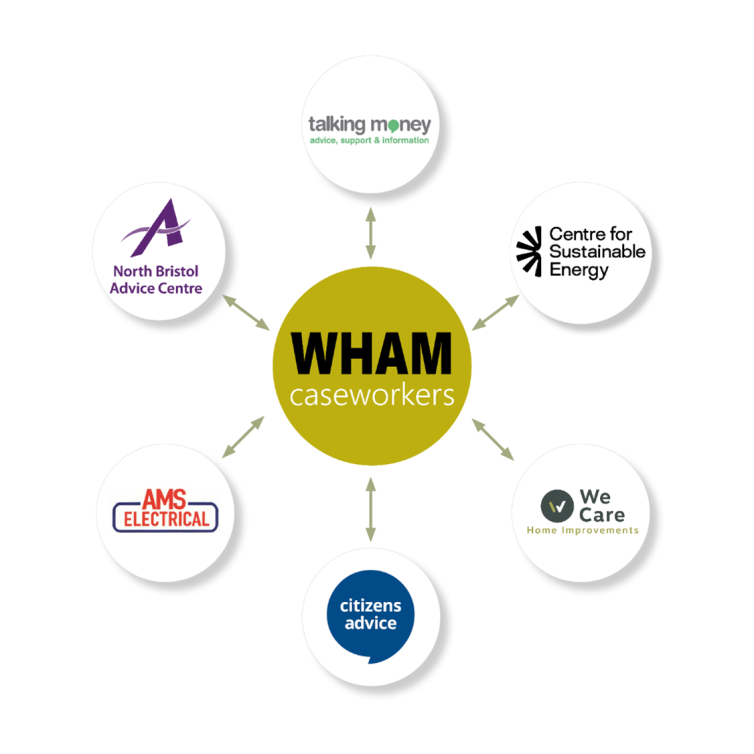
The partner structure for the WHAM 2 project
WHAM casework has always focused on helping people with their immediate difficulty and then enabling people to become more resilient once they’re out of the crisis. To meaningfully address client issues, we provide in-depth casework and with the help of our partners, enable people to move on and no longer rely on support services. And we know our approach works, because we very rarely see people being referred back into the project.
Lisa Evans, WHAM Project Manager
Project deliverables
The project’s integrated partnership approach employs caseworkers who work in rotation across all partner organisations, benefiting from each partners’ knowledge and embedding fuel poverty expertise within each organisation. This approach encourages knowledge, resources and skills sharing between the partners, to offer increased support to people struggling to heat and power their homes.
The caseworkers support residents by undertaking in-depth casework involving home visits, phone calls, emails, face-to-face sessions, advice events, workshops, and sharing resources through social media and leaflets.
They also deliver training sessions and mentoring to volunteers, partners and local organisations to raise awareness of the effects of fuel poverty and how to refer people into the project.
WHAM caseworkers support people with extra vulnerabilities. These people can’t always just call up an advice line and get the information they need. Some people greatly benefit from having someone in the background to work out the next steps and give them the confidence and help to resolve problems. Caseworkers also help with developing the transferable skills to solve problems.
Rachel, WHAM Caseworker
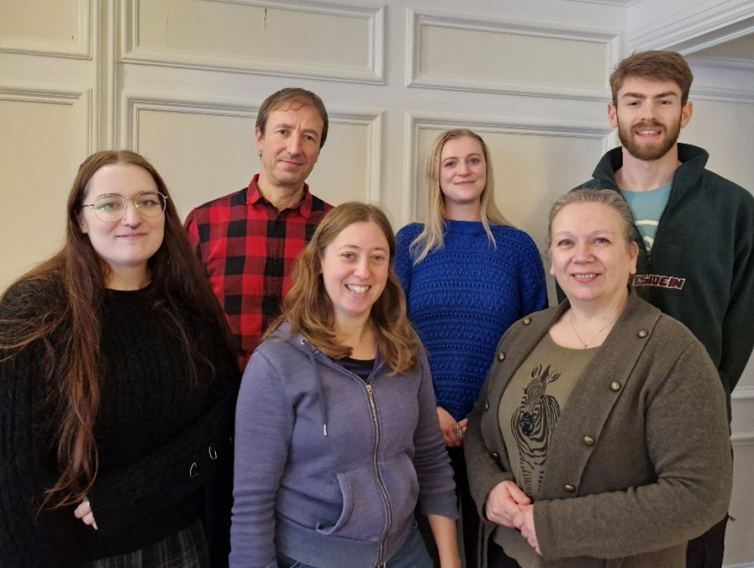
WHAM 2 project caseworkers
Project impact
During the project period: September 2023 to August 2025, 2,144 residents received in-depth support with an average saving of £418 per household.
36 volunteers supported the project and were trained to offer advice and support to households alongside the caseworkers.
75% of householders felt they had increased knowledge and confidence of how to monitor, check, and pay fuel bills, and how to manage their energy more effectively.
A further 85% said that they feel less anxious about their finances or their energy following their intervention.
Throughout the project, the team developed many resources to complement their advice, including a couple of short films; heating tips and explaining the price cap 2023. They also created a webpage of energy advice resources for tenants of housing provider Caridon.
Living with multiple disabilities has been exhausting and isolating. But Andrew, through all of this, you have listened to me, supported me, and consistently looked for ways to make my home warmer and safer. Your compassion has meant more than I can ever fully express. Your support has made a real difference not just to my home, but to my heart.
WHAM service user
An example of good practice
The project has been highlighted in multiple publications as an example of good practice.
Including Public Health England’s ‘The 2nd Atlas of Variation in Risk Factors & Healthcare for Respiratory Disease in England’.
They also feature in Ofgem’s ‘Vulnerable consumers in the energy market: 2019’ report for sustainable and innovative advice provision.
Building on project learnings
Undertaking the project has provided the team with learnings and knowledge, to efficiently support households with their energy bills and develop the organisations casework projects for the future.
Learnings include:
- Keeping up to date on what partners and other agencies can offer and their waiting times. In this way caseworkers are informed of what support is available to make referrals or signpost accurately and manage expectations.
- Enabling householders to do as much as possible for themselves. This not only helps the caseworker but also gives people much-needed agency over their situation.
- Having triaging in place to identify those that need support urgently. This also gives the referral process a structure which is less overwhelming for the caseworkers.
- Running mentoring sessions and catch-ups with caseworkers to ensure they aren’t feeling overwhelmed or overloaded with work.
- Recording trends in residents’ concerns to understand how to respond and if anything can be done to alleviate these concerns through their communications team.